
« `html
The AMD Opteron X2170 represents a significant milestone in the history of processors, particularly in the server and high-end workstation segments. This processor, launched in 2013, aimed to offer unmatched performance and core density for its time, responding to the growing needs of demanding applications such as virtualization, data analysis, and high-performance computing. Unlike consumer-grade processors, the Opteron X2170 was designed for reliability and scalability, with support for large amounts of memory and multiple sockets, allowing for the construction of highly powerful systems. Its arrival on the market marked a significant change in AMD’s strategy, which sought to position itself as a key player in the server domain, after years of Intel dominance. Understanding its architecture and characteristics is essential for appreciating its impact and place in the computing landscape. Competition was fierce, with Intel offering its own solutions, but the Opteron X2170 stood out through its core density and innovative architecture.
What is the architecture and technical specifications of the AMD Opteron X2170?
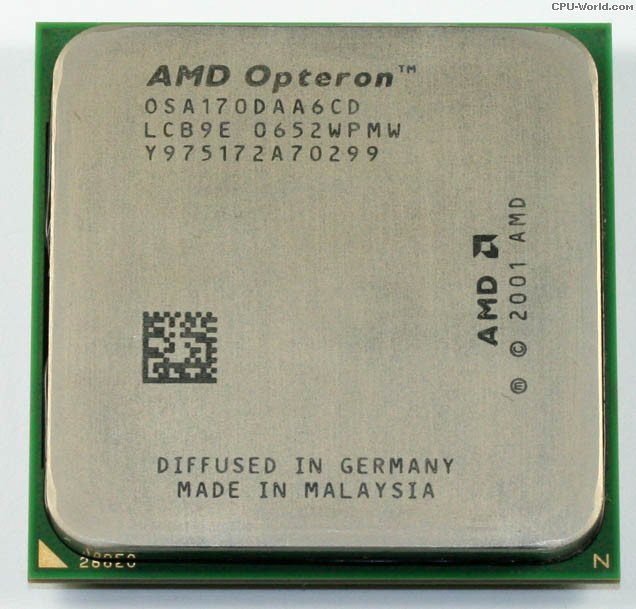
The AMD Opteron X2170 is based on the « Abu » architecture of the Bulldozer family, representing a significant evolution from previous generations. This processor features an unusual configuration: it actually combines two Bulldozer modules into a single package, giving a total of 12 physical cores, but 24 threads thanks to AMD’s Simultaneous Multi-Threading (SMT) technology. Each Bulldozer module is itself composed of two Piledriver cores, an improvement over the previous architecture. The base frequency of the Opteron X2170 is 3.0 GHz, with Turbo Core going up to 3.5 GHz, allowing for dynamic speed adjustment based on workload. The TDP (Thermal Design Power) is 215W, reflecting its relatively high energy consumption, typical of server processors. It is manufactured using a 32-nanometer fabrication process, an advanced size for the time. The Opteron X2170 supports a large amount of memory, up to 768 GB of ECC (Error Correcting Code) RAM, crucial for server stability. The memory bus is 6400 MT/s, offering a high data transfer rate for communication with memory. Although it does not feature an integrated GPU, its open architecture allowed for flexibility in integrating dedicated graphics cards, depending on needs.
A deeper analysis of the Bulldozer architecture
The Bulldozer architecture itself was AMD’s attempt to densify the cores and improve energy efficiency. Each Bulldozer module combines two physical cores, sharing the same computational units and L2 caches. This approach allowed for reduced die size and decreased power consumption, but also introduced challenges in per-core performance. The SMT technology allowed each physical core to execute two threads simultaneously, increasing instruction throughput and improving processor resource utilization. The two-core-per-module design was criticized for its impact on per-core performance compared to competing solutions, but the Opteron X2170, with its 12 cores, compensated for this by its overall processing power.
How does the Opteron X2170 position itself in the market and what was its price?

The AMD Opteron X2170 was positioned as a high-end processor for servers, workstations, and high-performance computing environments. Its arrival on the market in 2013 aimed to directly compete with Intel’s multi-core offerings in the enterprise segment. It was designed for applications requiring high core density, such as virtualization, database management, data analysis, and scientific computing. The Opteron X2170 was part of AMD’s strategy to strengthen its presence in the server domain, after struggling to regain its place against Intel’s dominance. The Opteron X2170’s price upon release was around $1700, placing it in the high end of server processors. This price reflected its manufacturing complexity, computational power, and support for large amounts of ECC memory. While it did not completely reverse Intel’s dominance, it offered a viable alternative for businesses seeking high core density and overall good performance.
What are the real performance of the AMD Opteron X2170?
The performance of the AMD Opteron X2170 varies depending on the workload and system configuration. In multicore benchmarks, it generally competes well with Intel processors of the time, thanks to its high number of cores. However, in terms of single-core performance, it was slightly behind Intel solutions due to the Bulldozer design. In terms of FPS (Frames Per Second) in games, the Opteron X2170 was not its strong point. While it could run games, it did not compete with consumer-grade processors or dedicated gaming solutions. Its strength resided in applications requiring a large number of cores, such as video rendering, simulations, and virtualization. Tests demonstrated that it could effectively manage a large number of virtual machines, making it an attractive choice for data centers and virtualized environments. Compared to other processors of its generation, such as the Intel Xeon E5-2697 v2, the Opteron X2170 offered a good performance-to-price ratio for specific applications that benefited from its core density.
What technologies does the AMD Opteron X2170 support and how can it be used?
The AMD Opteron X2170 supports a full set of common technologies in the server and workstation world. It supports the latest versions of DirectX and OpenGL, essential APIs for many professional applications. The Hyper-Threading technology (AMD equivalent: Simultaneous Multi-Threading) allows for increased instruction throughput by executing two logical threads per physical core. ECC memory support guarantees data integrity and system stability, crucial for critical environments. The Opteron X2170 does not natively support CUDA, a technology developed by NVIDIA for parallel computing acceleration on GPUs. It is also compatible with AMD-V for hardware virtualization. Recommended uses for the Opteron X2170 are primarily in the professional sector. It excels in virtualization environments, database management, data analysis, video rendering, and high-performance computing. It can also be used in workstations for 3D modeling, scientific simulation, and other demanding tasks.
In the same range, we find the 3280.
In conclusion, the AMD Opteron X2170 left an indelible mark in the world of server processors by offering impressive core density and an innovative architecture. Even though its single-core performance was not on par with the competition, its ability to handle many tasks simultaneously made it a relevant choice for businesses and professionals. It represents an important step in AMD’s strategy to reclaim the server market, and its legacy continues to influence the design of modern processors.
« `
